

Mar 15, 2026
Updated
Written by Gregory Shein, CEO & Founder
What Is a Retainer Fee? How Retainers Work for Agencies and Freelancers
A retainer fee pays for an agreed period of services or availability. The agreement defines what the client receives.
A retainer fee is a payment for an ongoing service arrangement or reserved availability, often covering a monthly period. For agencies and freelancers, it can make repeated work easier to plan: the client knows what support is included, and the team knows what it has committed to deliver.
The word “retainer” does not determine the scope, payment date, unused-hour policy or extra-work price. Those terms need to be agreed explicitly. This guide covers service-delivery planning; it does not prescribe legal or accounting treatment.
Three common ways to structure a service retainer
| Structure | What the client buys | What to review |
|---|---|---|
| Hours-based | A defined allowance of service hours for a period | Hours used, remaining commitments and approved extras |
| Scope-based | Specified recurring deliverables or services | Deliverables, revision limits and acceptance criteria |
| Availability-based | Agreed access, response windows or reserved capacity | Availability commitments, response expectations and service boundaries |
Real arrangements may combine these structures. A scope-based retainer can still use internal time tracking to understand delivery cost. An availability retainer should define whether it includes delivery hours and, if so, how many. Neither structure implies unlimited work.
A monthly example: $1,500 for up to 12 delivery hours
Northstar Studio (Demo) is a fictional client in Corcava. Its September 2026 design retainer includes campaign graphics, layout revisions and delivery review for a $1,500 monthly fee, with a 12-hour delivery allowance. New branding, copywriting and rush requests are excluded. The example has no rollover and requires separate approval for extra work.
Eight hours are recorded at a $50/hour cost rate. The manual review therefore shows:
- Four hours unused: 12 included minus eight recorded.
- 66.7% allowance used: eight divided by 12.
- $400 recorded labor cost: eight multiplied by $50.
- $1,100 modeled contribution: $1,500 fee minus $400 labor cost, before other costs.
The contribution margin is 73.3% on that limited, fee-based calculation. It is not a native retainer margin metric, recognized accounting profit or cash profit. The saved invoice is a draft with $0 paid.
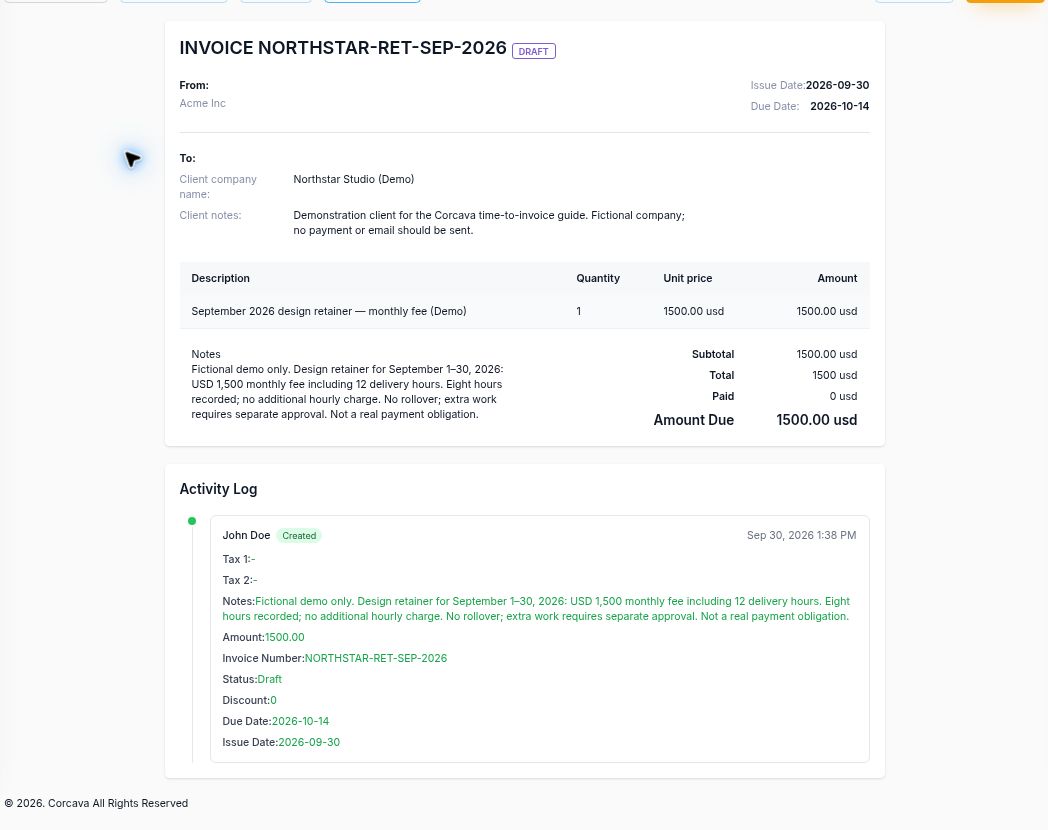
One monthly fee line covers the agreed period. The eight included hours are not added as an extra hourly charge.
See the complete design-retainer walkthrough for the saved scope, rates, time entry and report. The four-hour balance must still be compared with unfinished commitments before you promise more work.
Retainer fee versus hourly billing or a project fee
With hourly billing, the agreed invoice amount generally depends on approved hours and rates. A fixed project fee depends on defined scope or milestones. A period retainer depends on the services or availability agreed for that period.
For a $1,500 monthly fee, recording eight hours does not automatically reduce the invoice to eight hours of charges. Equally, recording more than an allowance does not automatically authorize an extra charge. Review the agreed terms and obtain any required approval.
An advance payment for one project can have different terms from a recurring service retainer. Record the covered work, period and billing conditions clearly rather than relying on the label. Compare the three operating workflows in Retainer vs Fixed Price vs Hourly.
What to settle before starting
Put the commercial decisions in writing so both sides can review them:
- Included services, deliverables and revision limits.
- Covered period, fee, currency and payment timing.
- Named contacts and a process for prioritizing requests.
- Any hour allowance and which activities count toward it.
- Response expectations and excluded services.
- The treatment of unused allowance, including any expiry rules.
- How extra work is estimated and approved.
- Review, renewal and ending arrangements.
Use terms suitable for your own engagement. A project description or tracking worksheet can preserve the operating reference, but is not a substitute for an appropriate agreement.
How to review whether the fee fits the work
Estimate the effort needed to meet the commitment, then apply a consistent cost basis. Include the overhead and other delivery costs relevant to your decision. Reserved availability may constrain what else the team can accept even if the client uses fewer hours.
During the period, record actual work and compare it with both the allowance and unfinished commitments. At the end, review changes in scope, revisions, responsiveness and delivery cost. Use those observations when discussing the next period; a single light month is not a guarantee of future margin.
The retainer profitability calculator can help explore assumptions. Its results depend on the inputs and are separate from saved application invoices and payments.
What Corcava records, and what you review manually
Corcava can hold the client and project, record time, apply project rates in reports and save a manually entered monthly-fee invoice. In the Northstar example, the hour allowance is written in the project description. Allowance usage, unused hours and fee-based contribution are calculated separately.
The current recurring generator does not repeat the configured fixed retainer fee; it builds line items from time and associated expenses. It can queue invoice email when a client email exists. Read the recurring-invoice documentation before using those settings.
Use the retainer tracker PDF to keep the period, agreement, hours, commitments and invoice review together. It is a printable manual worksheet. It does not automatically calculate rollover, send reminders or reconcile time against an invoice.
Common questions
Is a retainer always paid in advance?
Payment timing depends on the agreement. State the covered period and when the fee is due. An unpaid invoice is not evidence that money was received.
What happens to unused hours?
Follow the agreed terms. The Northstar example uses no rollover. If your arrangement allows rollover, record the eligible balance, expiry and approval manually; do not assume the software transfers hours automatically.
Do retainers require time tracking?
Hours may or may not set the client-facing fee. Tracking effort can still help a team understand cost and future commitments for scope-based or availability-based work.
Can the same team use retainers and project work?
Yes. Keep delivery records consistent, identify the commercial agreement for each engagement, and review each invoice against that agreement. Included retainer work should not also be billed as an hourly extra.